Tuesday, August 30, 2011

Running Through Ramadan


This evening around 6pm, after a day of apartment hunting with a friend, working on my computer on an NGO project, and catching up with phone calls after the weekend, I psych myself up and set out to run.  I pass by my guardian and his family sitting on their patio downstairs.  “I ni ce,”  I greet them.  “K’an ben sooni.”  I’ll be back soon!  My downstairs neighbor waves at me with a cigarette in his hand- “Wait,” he says to me in French, “I’ll go get my things and then I’ll accompany you on your run.”  “Next time,” I reply, and his laughter follows me out of the courtyard and down to the newly paved road that I call my street.  I didn’t bother to ask if he’d run with the cigarette or without it… 
The newly paved road where I start my runs.  

 
Moments later, my feet are pounding the pavement and my legs were feeling good.  After missing a long run yesterday due to too much fun and too little sleep the night before (oops), they are feeling fresh and limber.  I pass by the impressive Chinese building (not the embassy, but a consulate?) and the sign for the “Le Manguier” hotel and bar that I’ve wanted to check out since passing it during a run last week.  I head for a boutique a few blocks ahead and hang a left just across from it on to a dirt road that has turned to muddy red slop after a day full of rain and drizzle.  I can’t complain, because I love the overcast sky and the temperate conditions that make this run feel invigorating and comfortable rather than stifling and difficult in the heat of the sun.  

My route takes me past a lot sometimes used as a soccer field and across a small bridge covered in earth.  I choose the wrong path through some brush instead of negotiating puddles and I end up with muddy, squishy tennis shoes.  I turn right where the path leads away from the river to the main road near the Magnambougou market.  I look out for sotrama vans as I cross onto the pavement and start up the hill that will take me to another dirt road and another neighborhood area- I prefer these quieter dirt streets to the busy exhaust filled thoroughfares in the neighborhood… even if they are riddled with rocks and other potential ankle twisters. 
As I wind through the streets I pass the Catholic church belonging to my local quartier and I head back towards the paved road.  My eyes on the street, I look out for potholes, rocks, puddles and streams of water to avoid.  Gradually, I realize that the trickling stream I am watching wash down the street is not clear or muddy, but bright crimson red!  It’s water filled with blood, and I look back to catch a glimpse of an animal being slaughtered outside a family compound.  This is, after all, the last evening of Ramadan, the holy month of Islam.  Families all over the quartier, the city, and most likely the country are sacrificing animals at this time and preparing to break a month of fasting by treating themselves to feasts of meat and other specialties!
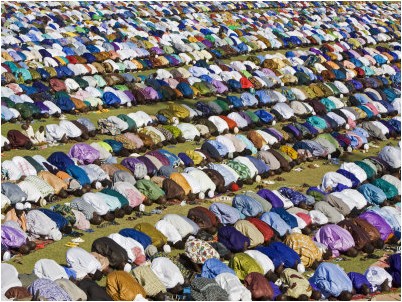
Praying at the end of Ramadan in Mali
The past month has flown by.  I had some expectations for my first Ramadan in a Muslim country.  I expected tired and crabby people to cross my path and bring me down.  I was worried about offending people by eating and drinking during the day while they were trying to go without any foods or liquids (including water!).  But, in true Malian fashion, people remained mainly upbeat and understanding about the way things were going this month.  Ramadan doesn’t seem to have such hard, fast rules in Mali.  I met many Muslims drinking tea as usual or waiting to fast until “next week” because they weren’t feeling well.  Granted, fasting is not a requirement of the ill, pregnant, breastfeeding, old or very young, but here there seems to be little outright disapproval of those eligible to fast who might not for a day or two or more.  When I explained to people that I was Christian and that even if I fasted, it would lack the religious significance of their actions (fasting is meant as a way for Muslims to learn about patience, spirituality, humility and submissiveness to God by giving up food, drink, sex, etc.- think a little like Lent), they seemed to understand and excuse me from even trying.  Of course, every once and I while, I ran into the odd person who would tell me I couldn’t handle it or that it would be far too hard.  Those of you who know me understand the power of these words and my need to explain their speaker’s misunderstanding of my capabilities.  To these people, I explained that I was training for a half marathon.  Running many kilometers a day.  Working very hard at sports.  I NEED water, I would explain.  I am strong and physically fit.  But I need water to keep me healthy.  This was a good way to validate my need for food and drink and most people seemed to understand… or at least to accept this explanation.  I guess I could have always just begged sickness….

With my friend, Ryan, after my first half marathon.  April 2010.
But, in fact, I am training for a half marathon.  Next month, I will run through the center of Accra, Ghana with other expats and West Africans to complete my second half marathon (in sh’allah… God willing… ).  I began training at the start of this month of Ramadan and am now up to 10 mile long runs and feeling pretty good about it!  This running has given me my own chances for reflection and thought during a month of reflection and holy focus.  I have discovered beautiful places in my own neighborhood that I never would have found by car, enjoyed the rain and the cool weather, cleared my head, felt healthy, and even established a bit of a routine. 

My favorite times to run are early on weekend mornings and around seven in the evenings on weekdays.  These are the quietest times in my neighborhood and the surrounding quartiers and also the coolest times of the day (for those of us who aren’t willing to get up at 5 or 6 am or run late late after dinner around 10).  Running at these times helps me avoid the most potent exhaust fumes and the most congested times when narrow roadways are filled with pedestrians, motos, and cars.  I hear far fewer chants of “Toubabou!!” (white person!) and am far less likely to be nearly run down by motos (it has happened, sadly enough, even on wide roads).  If I never have to hear a child yell “bobaraba” at me again, I will not be disappointed (this means “big bootie” or “fat ass,” depending on how much benefit of the doubt you give to the namecaller). 
Ordered new shoes!  I hope they get here soon!

Long runs on the weekends bring the added benefit of variety- I can go places that I can’t make it to during shorter runs throughout the week.  I most enjoy running out past the Magnambougou market to the road leading to the third bridge that is almost ready for inauguration and traffic (or at least it looks that way to my non-engineering eye).  As you reach this route, there is a small turn off on a dirt road running towards the river.  The road takes you over a bridge, onto a concrete platform, across a one-person-wide pier and onto a dyke that runs east with the river creating a canal between it and the shore next to the road.  This dirt path is wide enough for cars, but only hosts motos, cyclists, and pedestrians, and is not often highly populated at 7:30am on Saturdays or Sundays.  The wind, the sound of water rushing under a small dam, and the bird calls and chirping bugs are the closest semblances to the beach I have found here in Bamako.  While I run on this strip of land, I enter a state of Zen that I don’t even allow reckless motos to penetrate.  I like the calm quiet of the morning hours and am still amazed by how much I can accomplish before noon when I get up and run at 7!!

But the most magical time to run is at 7pm on weekdays.  During Ramadan and every other month of the year, 7pm is about the time for the late evening call to prayer.  But, during this month, the 7pm prayer takes on a particular significance.  This moment signals the end of the day’s fast and the beginning of a large communal meal, started by steaming kinkileba tea or maybe some dates and milk.  Running at this time is a really awe inspiring experience.  The roads are empty and peaceful as members of Mali's 95% Muslim population join with their families for a meal to break the fast, and the competing calls to prayer resound from the mosques in the area.  Running down a dirt road in the fading sunlight, past a mosque where men are praying on mats lined up outside the door, I can’t help but be amazed that this is where I live and this is the place that I have gotten to call home for the past year.  During these moments, I’m honestly glad that I forced myself to put on my muddy tennis shoes and head out to the busy city streets for some exercise. 
Sometimes the sky is this beautiful during evening runs

In addition to the moments of introspection, calm roadway conditions at 7pm (in fact, the whoe traffic rush hour pattern shifted so the bridges became packed at 5 pm instead of 6 or 7) and shorter lunch waits at restaurants, and despite the decrease in street food vendors and the even shorter than usual attention spans during meetings (or the lack of attendance in general- experienced in Banankoro a couple of times this month), Ramadan offered a sense of ritual even to this non participant’s day.  By running regularly and observing revised traffic migration patterns, I felt at peace more often this month.  I hope this will remain true in the coming months I have yet to spend in Mali and throughout the decisions I will be making in the near future.  Though I haven’t had to wait all day for a bite to eat or something cold to drink, I have learned ever more about the importance of patience this month- patience with training programs, with tired fasting Malians, with the speed of project conclusions, and with the need to make big decisions and travel plans.  I hope that we can all hang on to this patience that Ramadan has showed us.  We shall see, beginning tomorrow morning, as I spend time with my host family and negotiate my way around to greet other Malian friends in my stiff bazin fabric and fancy shoes.  I know my patience will be tested as this city of millions attempts to do the same.  Let’s just hope it doesn’t rain… In’shallah!

Tuesday, July 26, 2011

Rules of the Road: Volume Two


Some ominous clouds and a rainy windshield in ACI 2000 this morning
As a tip of my hat to the current rainy season, and today’s conditions specifically, the second volume of the Rules of the Road series will be entitled:  

Rainy Days Don’t Get Me Down.

I have already written about some of the beautiful things that rainy season brings.  Cooler air, soothing sounds, interesting sights- all of these are the positive staples of “l’hivernage” here in Bamako.  However, rain does present some unique concerns and interesting scenarios when it comes to driving in the city.  However, I find that the rain brings more positive qualities than negative ones when it comes to getting around in my car (or at least that’s what I’m going to keep telling myself).  

A few positives about driving in the rain:
1.   (Almost) No Motos!!!  This may be one of the best benefits of downpours and sprinkles in Mali.  Roads that are usually jammed with moto bikes that make me nervous at best (and road-ragey at worst) become shockingly calm.  The first time I drove in a big rain here, I couldn’t figure out why things seemed less stressful even though I could barely see a foot in front of me.  I attribute this to the lack of motos on the roadways.  A bonus is that if you drive past a gas station with a bit awning or under an overpass, you get to see herds of moto drivers hanging out and waiting for the rain to pass.  A secondary bonus is that you also see a few brave souls driving through the pelting rain- sometimes in full rough weather gear (think bright yellow hooded rainslicker with matching pants) and other times wearing plastic baggies tied around the head to protect a precious weave or braids.

Traversing the new bridge this morning.  Light traffic!  Better... NO motos!!
2.  Drivers are often a little more prudent on the roads during times of monsoon.  During a couple of excursions I made during downpours, people were inching along the roadways and being a little less hasty with their turns and risky intersection crossings.  Of course, you’ll always run across a couple of jerks who think that the rain doesn’t apply to them, especially if they’re in their big SUVs or giant trucks.  But for some reason, I feel less angry and more sorry for these drivers in rainy conditions. 

3.  Which brings me to another big positive—my attitude and patience level in the rain.  I just feel less pressed to get anywhere when it’s raining.  In fact, there are times when I have (very acceptably) cancelled meetings or plans because of the rain and a real hesitancy to drive in it on a particular afternoon.  I guess it’s harder for me to get caught up in roadway competition (real or imagined) when there are such adverse driving conditions to focus on.


4.  Another great thing in the rain, though not really about it… my new tires and windshield wipers!!  At the beginning of rainy season I was terrified to go even a short distance if it was raining because my tires were basically bald and my windshield wipers only made comtact with a sixteenth of my windshield.  Now, with brand new tires and wipers, I am no longer afraid of hydroplaning at the slightest touch of the brake or of hitting something because the windshield is too wet and blurry.

My sweet new wheels!   No more hydroplaning.
 5.  You get to see funny things when you’re driving in the rain (if you have time to pay attention because your windshield wipers work properly).  From the aforementioned plastic bag hairnets and full rain gear to fancy canvas window covers for the sotramas (I was shocked at how nice these covers are because the big green vans themselves are often in miserable shape!), and makeshift umbrellas, there are things to be amused by when on the road in the rain.

6.  A rainshower is a free car  wash… and my car is always in need of one of those!

Of course there are some downsides to rainy day driving…. Hidden potholes, puddles that could be shallow or could be oceans- you never know, crazy drivers who don’t seem to notice the rain, getting to/from and in/out of the car, the mud, the mud, the mud…   But, I think I’m getting used to taking most of these things in stride.  I didn’t let the rain foil my plans to run errands this morning… after all, it’s really much easier in a car than it is on foot, by bike, or even via public transportation.  So Rule of the Road Number 2 might be restated:  Rain can be a blessing, especially when you have your own car!

Tuesday, July 19, 2011

Rules of the Road: Volume One

Baby Car back in November just after I bought her
I apologize for the drought of interesting blog entries.  Things have been busy and I haven’t been so great at making myself sit down and write about the things happening here every day.  To be honest, I can’t tell you about my routine because I just don’t have one.  I started to think about the things I could share about my stay here and my day to day life.  One thing that never ceases to be a burden and a benefit is my car.  Driving in Bamako is an adventure every day.  It is one major source of my proudest accomplishments, biggest time savers, greatest frustrations, tears, anger, relief, and much more.  There are days when having and using my car make things so much easier and put me at ease.  And other days when I get pulled over multiple times, get flat tires, have to sit at the garage, get screamed at by crazy Malian chauffeurs, and end up generally frustrated.  What better stories to share than the ins and outs of these extreme emotions and (hopefully) interesting anecdotes?!? 

Rule of the Road Number One is: Creativity is Key
Rule of the Road number one could just as easily be that there are no rules, but this would be exaggerating just a bit.  Rather, I like to think of this rule in terms of positives- meaning that creativity and innovation are key parts to driving in Bamako.  Being a clever driver is always useful because it can help you 1) cut in front of more cars, 2) get places more quickly, 3) avoid more accidents, 4) avoid getting pulled over, 5) and generally make for less waiting and more eventful car trips. 

Creative driving includes, but is not limited to:  using the shoulder to avoid waiting in traffic and then cutting in front of all the cars you just passed; driving in the middle of two lanes to prevent anyone from passing you and thereby maintaining your position “in front”; slowly inching into traffic until you have completely blocked one lane and drivers are forced to let you turn in front of them or cross a street; passing slow moving cars on narrow roads with finesse and (sometimes reckless) agility; having your broken down van towed by your friend’s two door starlet to get it to the garage (I don’t think I’ve ever seen a real functioning tow truck here…).   But two of the biggest keys to creative driving that I have noticed are short cuts and detours. 
Traffic on the "new bridge"- four lanes with a median!


Every taxi driver has his own short cuts.  He might take you down a dirt road that zig-zags through a quartier that you didn’t even know existed just to avoid a police post where he might get pulled over.  He might take you down a street he knows has a great fruit selection because he wants to buy some mangoes, but also because he swears this way is faster (of course).  Similarly, taxi drivers are usually excellent when it comes to detours.  In the city, streets (or worse, bridges) can be closed inexplicably (or for instance, at commonly known but never posted times like Friday during the afternoon prayer), routes can be blocked entirely by accidents at rush hour, or traffic jams can make attempts at forward motion so futile that you feel forced to change your route.  There are never posted detours during any of these times.  In fact, even during road work there are never any signs offering assistance to drivers seeking a way around the mess that is created while improvements are being made.  In a city where road signs are almost non-existent to begin with, detours are just as important as short cuts and must be memorized through experience or trial and error. 

I am beginning to feel more and more capable and more and more Malian in my mastery and use of short cuts and detours.  I know that if the traffic for the old bridge* is backed up to the last light before my house, I should cut down a parallel side street and turn right into traffic just before the bridge, avoiding up to a 20 minute wait.  I know that if I take the old bridge, I should make an immediate left upon leaving the bridge instead of sitting on a one way road waiting to turn right and being “cut” by big trucks and annoying taxis.  I now know at least four different ways to get from my neighborhood to the Hippodrome neighborhood where several friends live and I have even come up with variations on these four major trajectories.  In cases of bad traffic or accidents, I detour accordingly.  In short, I feel like I have gotten to know Bamako over time by driving around town and operating through trial and error.
Crossing the "old bridge"- two lanes and lots of proximity to motos

However, I was reminded this weekend that I shouldn’t feel overconfident about my shortcut savviness.  The crazy drivers and traffic patterns in Bamako can always find a way to throw “sure things” for a loop.  It was Saturday around noon.  I was running a little late for lunch at my research assistant, Binta’s, house.  The bridge gave me little trouble and I wasn’t even sweating too much as I approached my favorite and most clever shortcut…. The fruit road by the French embassy that helped avoid the  crazy one-way street near the Bank of Africa (I know… these landmarks aren’t very helpful, but just know that I had historically saved up to 20 minutes of waiting time using this very shortcut!).  I waited a little longer than usual after making my turns and it slowly became apparent that no one was moving- not the line of cars I was waiting in or the vehicles approaching the intersection from the other road.  There was actually a police officer directing traffic, and as I approached the intersection (eventually, and slowly), I tried to make eye contact and indicate that I didn’t understand what was going on.  People seemed to be turning around, and it appeared as though there was a bus up ahead blocking the narrow thoroughfare.  Still, it didn’t look like anything too grave.  However, the officer was making everyone in my lane turn left or make a U-turn to avoid the road ahead.  Once I gathered this and decided on the U-turn option, I took a moment to shake my fist at the middle aged man behind me blaring his horn and yelling at me as though I was the one to cause the need for a detour, and then I turned. 

During my shortcut, I snapped pictures of this trash pile on the route
Now, I had a problem.  I was back at square one where I had exited the bridge, and I had no idea how to get around the particularly tricky stretch of road that was blocked.  A similar scenario had presented itself before- that time I was coming from the opposite direction at night and found the road blocked by three semi trucks who had not done a very good job of sharing an intersection.  I had to totally retrace my route and make a  large arc around the scene of the jam.  On Saturday I had no particular desire to make a huge detour out of my way and I knew there were back roads frequented by taxis, semis, and other vehicles, so I decided I would risk it.  I called my research assistant and got instructions from her husband and set out on a bumpy dirt road that was filled with other motorists cleverly avoiding the roadblock in the same way that I was. 

Cows eating trash while I wait in traffic taking a detour
The detour was relatively uneventful, and Binta’s kind husband, Cissouma, met me along the route to guide me the last bit towards their home.  Even that was a little tricky as a road that was normally passable had been blockaded that morning by huge trucks and some makeshift barriers.  Finally, I arrived Chez Binta, only 20 minutes late and a little sweatier for the effort.  But now, I was armed with a route that could be a useful detour in the future, or even a new short cut!  Over fonio (Malian cous cous) and delicious peanut sauce (Binta added cabbage because I told her I liked it a lot), we discussed research, English language, photography, their son, Oto, and of course- the lamentable route that ran past their neighborhood and had caused me momentary difficulties.  “It’s terrible!”  Cissouma agreed, in a supportive way.  He suggested I give myself extra time to get home before my next engagement so that I could have time to spare in case of heavy traffic.  I willingly agreed and headed out to face my destiny on the road…. Fifteen shortcut-less minutes later, I was home without a hitch.  Thanks to a little creative driving (I blew by a slow moving truck before reaching the bridge, and blared my horn at some taxis trying to cut in front of me from the side of the road), and a fortunately minimal amount of traffic, I had an uneventful trip- the best kind! 

Be sure to stay tuned for upcoming entries on other things that can make for eventful car trips…. Read about my tactics for avoiding police officers and about my experiences with Malian mechanics!

*The city of Bamako is separated by the Niger River.  I live on the south side of the river in a slightly more residential area whereas the city center, biggest markets, US Embassy, and many friends are on the North side of the river.  The two halves are connected by two bridges… the “old bridge” is a 2 lane bridge closest to my house that leads straight into the main market.  The “new bridge” is a 4 lane crossing point that goes close to the US Embassy.

Sunday, June 26, 2011

The Winds of Change


Rain last week at my apartment
I started this blog post last night* as the winds screamed and the dust whipped outside of my apartment.  With the door open to let the breeze come off my balcony through the screen, I could hear the storm brewing and take advantage of the strong cool breeze coming into my bedroom- ahhh.  It also meant a lot of dust made it onto my newly cleaned bedroom floor, but you win some and you lose some!  The wind was a relief on a night when my A/C unit didn’t seem to want to blow cool air, but it made for unsuccessful blogging.  I didn’t get much past the title of this post before my electricity flickered and then everything went black. 
It was really coming down!

The winds have really been picking up in Bamako and with them, come the rains!  I hope that this is a sign that the hot season is ending and the rainy season is well on its way to cooling things down and turning things green***!  We have had a couple of mango rains and a couple of teasers, but I am thinking optimistically that this is the start of something a little more serious!  Impending rain cancelled my trip to Banankoro last Thursday and forced me to retreat back to my house with my research assistant because I couldn’t even see enough to drive her home!  Earlier this week I got stuck in the car waiting for Zak to bring food from inside a restaurant.  He had to make a dash for the car when it became clear that the rain was not going to let up.  Today, the rain has forced me to stay inside rather than driving to Banankoro with my research assistant.  I was hoping to start a week of village stay to wrap up fieldwork, but alas, mother nature conspired against my plans by unleashing a downpour complete with booming thunder that sounded like a mine explosion (or at least what I imagine that would sound like).
My apartment building and neighboring phone tower after a big rain

The world is becoming greener, muddier, cooler, and more slippery, but the winds are not signaling just the coming of rain and the change of seasons around here.  I know I have written several times of changes going on, and I think that’s because it’s easier for me to write about the atypical or different things that happen to me here, rather than describing the day to day events that seem really routine to me.  This time, the changes are most significantly marked by an exodus of friends and colleagues and a vacation season (meaning lots of people taking trips to the US and elsewhere) that has left me feeling rather antsy to think about my plans for the fall  (and beyond) and to work a little travel into my life.    

Change: Zak's hair.  Before.
My weeks have still been consisting of a few days of teaching English and a few days of researching in Banankoro, but that, too is ending this week with my final English class and a push to wrap up interviews with village women and leaders.  By this time next week, I hope to be able to report that my fieldwork has really come to a close.  Now I transition into a period of basic analysis and “Where do we go from here?”  This question is one that has been creeping up for a while now, and I am now faced with a self imposed sense of urgency to create a game plan about what I can and will do in regards to the program that I have spent the past several months evaluating.  There is a long and complicated back story that accompanies this question and I’d be happy to share it with those of you who might be interested.  But I’ll just say for now that I am beginning to realize that there is only so much that one person can do and that a year is the blink of an eye in the scheme of things.
After.

More change will be coming soon, as my grant officially ends in August.  I am eagerly awaiting responses from applications submitted in April/May and will know within a few weeks what the general plan for my coming months will look like.  I may be jumping the gun a bit, but as so many around me begin to leave Bamako, I am beginning to feel like things here are coming to a close for me, too.  And in a way, they are.  But there is still a lot to do and much to enjoy!  However, it’s really never too early to start thinking about my next trip, right?  Weigh in, friends… Morocco, Ghana, Senegal, France?  What do you think….?
An exciting change!  The addition of a puppy to my life!  Meet Zira!

*I actually started this blog post about a week and a half ago (at the time, it was last night).  For some reason I have become terrible at finishing posts... I actually have several half finished entries sitting in Word waiting to be scrapped or saved...


**When I started writing this post, the arrival of rainy season was not yet totally apparent, but now, I think I can say that with rains about every other day it is here and picking up force.  
More change in Bamako- the third bridge being constructed in town


***Mali typically has a rainy season from June- September/October (or thereabouts) and the wettest month is August with an average of 8.7 inches of rainfall.  Temperatures decrease quite a bit during this time and the banks of the Niger River swell during this season.

Thursday, April 21, 2011

Segou Sunset


Segou Sunset as seen from our pinasse
The first time the alarm rings I am confused and can’t figure out what’s going on.  After my 10 minute “Snooze” grace period, I remember what the incessant beeping means and I drag myself out of bed.  After a quick shower I make my bed and straighten up- it’s always better to come home from a trip and be greeted by a clean house.  Ready with backpack and granola bars I walk out along the quiet dusty road to hunt for a taxi.  It’s early for me, but not really so early for my neighbors- the sun has already started to shed light on the day and the neighborhood is stirring.  I find a taxi without trouble and we stop to pick up Zak before heading to meet friends at a nearby restaurant, Amandine.

We arrive as they are hosing off the patio, washing off the grime and dust of one day to prepare for the traffic of another.  They aren’t popular at this hour, but at 6:30 they are already open.  We sit zombie like in front of the TVs and make simple conversation with two Canadian girls who will share our ride.  It’s too early for Zak to talk and my brain seems sluggish and reluctant to react to conversation.  This changes a bit when our car arrives.  Our friend, Cecilia, smiles and waves from the driver’s seat of a massive SUV with diplomatic plates and African printed seat covers.  She will be our driver for the weekend, a brave and economically sound choice for this trip.  Though they got as little sleep as I did, Cecilia, Erin, and Martha are excited for the trip and already energetic about the day.  I remember that despite my morning grogginess, I am excited for this trip, too! 

After a few hours in the car, expertly negotiating potholes and avoiding big speeding trucks, singing along to the iPod, and waving at villagers we pass along the route, we arrive at our lodgings- a cute little hotel and artist co-op at the edge of Segou near the river.  By this time we’re all awake and our group of five celebrates the start of our vacation with late morning beers, delicious tomato snacks, and some juicy juicy mangoes.  As the wind whips my hair and I laugh with friends on a lovely shaded patio I am so excited to be out of Bamako and starting this little adventure. 

Lovely travel companions Cecilia, Erin, and Martha
Bellies happy and legs stretched after the ride, fatigue begins to set in and even the enthusiasm we all share can’t buoy our energy levels quite enough.  A nap in the A/C is just what the doctor ordered!  After a couple hours sleep, I rouse myself and quietly shower and dress.  I choose a long skirt and wrap a scarf around my hair to keep it from turning to tangles in the wind.  I make a couple phone calls and set out to visit Mama Fatim, the woman who hosted me during my last visit to Segou in February.  Because we’re out of the center of town, I walk a ways before I find transportation.  It is hot hot hot this afternoon and I’m glad I’ve brought a nalgene full of cool water to stay hydrated along the roadside.  I pass venders and greet them in Bambara, usually getting a pleasant and encouraging reaction, but occasionally encountering some taunts and some “Toubab” chanting children.  Eventually, I find a moto taxi that will take me part way to my destination- all the way into town for just 100cfa (about 25 cents).  I attempt to make the entire transaction and trip in Bambara and it works until I realize I’ve gone too far and I have to explain to the driver that I need to stop immediately, please!  Luckily, I’m not too far off my route and I quickly find a taxi to take me the rest of the way.  A quick pause along the road to buy some mangoes and I arrive at Fatim’s, full sack of ripe orange mangoes in hand and only slightly sweaty for the effort. 

The visit with Fatim is a joy.  She is genuinely happy to see me and to inquire after my friends that she met during the last trip.  She demands why I would stay in a hotel when I know I can always stay at her place, and I explain that I am here just for one night with friends who will be leaving Mali soon- for good.  “Toi- tu ne vas pas quitter le Mali, n’est pas?” she asks.  You won’t leave Mali, right ?  « Il faut chercher un mari ici, » you should find a husband here !  “I love Mali,” I explain, “but my family misses me and hopes I will come home.  My grandmother recently sent me a note saying she loved me and thinks it’s time that I come home!”  This she understands.  “This is your mother’s mother?” she asks knowingly.  “It is like that with mothers and grandparents.  You should go home.  But you can find a husband here and come and go.  Some time here, some time there.  This is best.”  Madame Keita, a neighbor visiting for the afternoon, agrees with an appreciative cluck from over on her couch.  Now that this is decided for me, we move on to conversation about the politics of Africa.  Gbagbo on TV in his underwear, Gaddahfi and the rebel armies, and the dissolution of the government in neighboring Burkina Faso- “l’Afrique est gaté maintenant,” Fatim decides.  I offer my two cents, but there’s really not much else to say.  Africa really is “broken” right now in a lot of places.  So we move back to talking about friends and her son Cheik, who is in Bamako.  We see each other every so often and she inquires again about his health.  Then, nothing important left to say, a silence descends upon us, broken by only by the whirring of the fan, the soft snoring of Madame Keita who is now napping on her couch, and the sound of children playing outside in the courtyard.  I have grown more used to these silences, but they still remain more awkward for me than for most Malians, it seems.  When I announce a few minutes later that I should go, Fatim protests, “Already?” even though we’ve been sitting in silence for what seems like a while.  She ushers me to the road with a gaggle of children in tow and puts me on the back of a moto belonging to a man who eagerly volunteers to take me to town in lieu of looking for a taxi. 

Reunited with my friends in the city center, I peruse the offerings of artisan shops set up for the viewing pleasure of tourists.  This is the third time I’ve visited Segou in the past six months, and I’ve spent a bit of time near these stalls, so I have some old “friends” to greet as we walk up and down the street popping in and out of makeshift boutiques and dodging Tuareg salesmen all hocking the same leather covered boxes.  I do my best to greet salespeople in Bambara and try to pretend that I really know how to speak the language.  Even when a couple of vendors approach me in English, I respond in Bambara- it’s usually a better bargaining tool, it gives me practice, and it’s often met with enthusiasm along the way.  I make friends with a fellow Maiga (that’s my family name here in Mali) and buy a mirror that I didn’t even know I wanted.  When I become tired of the searching and the hounding, I sit under an awning and drink a coke with Cecilia while Erin and Martha play with the son of a fabric saleswoman. 

Drinking sweet and delicious bissap tea
The highlight of the day is just ahead.  We have arranged to take a pinasse along the Niger River for an hour and a half just as the sun is setting.  As we wait for Zak to join us, I negotiate with the boat guide and make a request for tea or delicious bissap (hibiscus juice) to be served during our tour.  I really like this guy, Ibrahim, and his crew member who is also a Maiga like me!  We share some friendly banter and I am assured that we have lucked out with this choice of guide!  As we set off on our journey along the river and across to peak at the neighboring Bozo village, the sun begins to set.  The setting is beautiful and the company couldn’t be better!  I sip delicious bissap tea (I guess maybe my Bambara wasn’t that great… instead of tea or bissap juice we got bissap tea- it’s awesome!) and look out over the river with my camera.  At this moment I am happy and I feel full.  A momentary silence comes over the group as the moon rises and the sun slips below the horizon.  Even a temporary loss of engine function goes practically unnoticed as we enjoy this relaxing ride.  As we pull into port, we thank the two guides who made our trip possible and I am genuinely happy to share some money with them and take their card so that maybe we can visit again.  In a place where I often feel pestered and have maybe become a little jaded, it’s nice to meet someone in the tourism business like Ibrahim, who is truly helpful, kind and accommodating. 

Fresh off the boat, we head straight to Djoliba hotel for brick oven pizza specials.  I load mine up with toppings, and the result does not disappoint!  Bellies really full and happy, we stop at another hotel for chocolate mousse, a glimpse of a soccer match on TV, and a wind down after the day.  I sleep well when I make it back to my bed and even sleep in a little the next morning because, hey- we’re on vacation!  And vacation it is on the lazy Sunday that follows.  After a lazy breakfast shared in the shade, all the girls pile into the SUV and we visit a Bogolon co-operative supported by the EU and run by local Malian women.  I debate over pillowcases and finally buy three after agonizing for far too long over decorating accessories.  We leave Zak to rest at the hotel (poor guy has come down with a cold) and continue on the Auberge hotel where we have made a date with their pool.  I spend the rest of my afternoon basking in the sunshine, swimming, and eating poolside, sharing girl talk with my friends.  I begin to take offense as the waiter acts annoyed at our group, his customers.  I would never treat customers with such an air of disinterest and resentment, I protest to myself, but I refuse to let him get me down because my food is good and the pool is brilliant!  This is a feat for me, and something I find I accomplish less easily during the day to day grind back in Bamako. 

Refreshed from a swim and an afternoon in the sun!
We pile into the car at the end of the afternoon, refusing the last pleas and offers from nearby vendors, and bid Segou goodbye.  I spend the next few hours singing songs with friends, swapping stories, and shifting back into Bamako mode as phones begin to ring and evening plans are made.  As with all good trips, I am sad to see this one end.  It marks the end of a weekend, the end of a “vacation” and the beginning of the end of my friend Erin’s stay in Mali- she will leave at the week's end.  I write about this trip now, in detail, because it was such a pleasant little surprise.  I always enjoy going to Segou and especially spending time with friends, but this simple weekend trip kind of jolted me out of a routine in a way that needed to happen.  I recently have come to feel as though I am sort of going through the motions here in Bamako- I research a few afternoons a week, teach English for a couple of hours, exercise in the evenings and schedule dinner plans with friends a few days in advance.  Even in Africa, things have managed to become a little “ho-hum,” and I’d like to avoid that as much as possible!  Mostly I think this will just take a slight change in attitude and a renewed sense of energy about each of my daily commitments- an effort that I need to make and a consciousness I feel I need to work harder to maintain every day.  But let's face it, a great mini-vacation once and a while surely doesn’t hurt!