Wednesday, April 13, 2011

It's Getting Hot, Hot, HOT!


Hot season has arrived in Mali.  Ok, it’s actually been here for quite a while, but it’s now in full force and I am daily reminded of its fury.  The first time I came to Mali, I arrived at the beginning of February- a month that grows hotter each day and begins the period not so fondly known here as “la chaleur” (the hotness).  But during this stay, I was lucky enough to experience a cooling of things in October and then a period of cooler days and evenings (more fondly called “la fraicheur” or coolness) that even necessitated sleeves at times.  Whereas before, I knew nothing but hot, this hot season comes with the knowledge of how pleasant the times really can be in Mali.  In that respect, it is just a little more cruel.  “La chaleur” reared its ugly head in earnest for the first time this year in early March.  After our weeklong trip to Burkina Faso, we arrived in Bamako to a hotter city and some of the other tell-tale signs of hot season’s arrival. 

NOTE:  Mali is always hot (by Indiana standards anyway).  Even in the “cold” season, daytime temps were usually in the 80s and the temperature at night rarely dips below the 60s.  However, during the hot season, we often see 105-110 degree days in Bamako, and at night, we don’t get much of a break.  There are nights when newscasters warn viewers that sleeping inside is dangerous, and each year, several people die due to heat related illness.  Days and nights this hot are characterized by other special qualities that one can only attribute to “la chaleur.”

Hot season staples:
  • A hotter wind- this quality is quite disappointing, because even on a hot day, a breeze can be enough to make things bearable.  But during the hot season in Mali, even the wind becomes warm, and driving with the car windows down just doesn't offer the same amount of relief that it does during other times of the year.
  • Dust- lots and lots of red dust.  Again, Mali is always pretty dusty, but the hot season is hotter and usually drier than most other periods of the year, and thus, things become quite dusty.  This means that I have to actually dust the leaves of the plants that are on my balcony!
  • Constant bathing- I have been bathing far more often than usual these past several weeks (and I typically bathe once a day anyway… ), like most Malians.  This is one of the things I was instructed to do by my host family when I was here before, and the necessity is still here this time around.
  •  Excuses- sometimes welcome and sometimes frustrating, hot season brings with it the ability to duck out of things “because of the heat.”  This can be very useful if you want to get out of an afternoon trip to the market or explain why you can’t visit a friend or family member until the later evening hours (thus making the visit a bit shorter!), but also very frustrating when you are conducting interviews and women refuse to come because it is too hot to leave their houses in the afternoon.  This can also work to the benefit of others and you might find yourself with cancellations for plans because it is “too hot” for your guests.  As much as Malians like to talk about being used to the heat, it can still be a deal breaker for many activities.
  • The sound of heat- I kid you not- this exists!  While sitting under the metal hangar in front of the Banankoro CSCOM a few weeks ago, I kept hearing a tinging sound that got me excited inside- I thought it was raining! Sadly, the sounds I thought were rain drops were really telltale signs of heat on the roof above me.  The flexing and swelling of wood and metal during these months really gives a sound to the heat that we feel all around us!

This post is probably not doing a lot for my case that everyone should visit me in Mali (seriously- I have a spare room!), but it’s really not all bad.  The hot season also brings a list of good things along with it and there are certainly other counteracting measures that I am grateful for during this time. 

Hott* stuff
A refreshing afternoon treat- lemonade by the pool!

  • Mangoes- These are some of Mali’s greatest gifts.  Maybe even a way of apologizing for the heat and making it more bearable.  For those of you who love mangoes or mango flavor, imagine multiplying that love by 10, because Malian mangoes are at least 10 times better than the imported ones you find in the states.  And there are so many kinds!  Sweet, sour, juicy, and colorful, these are heaven sent!
  • Mango rains- these little treats come just every so often, and usually at night.  The rain cools the air (before making it more humid) and brings that beautiful rainy scent to the ground.  We just had a little rain last night- just a teaser of what is to come in a few months. 
  • Thin cotton complets- these puppies are great, and they are an introduction for me into a whole other realm of Malian style.  I am working to gather my own collection of hot weather clothes, just like any good Malian woman.
  • Fewer mosquitoes- they don't like the heat either!  One thing we have in common....
  • Cold water and frozen juice- Have you ever been so thirsty that nothing sounds as good to you as a fresh glass of ice water?  Nalgenes full of cool H2O are better than ice cream or chocolate on days like those found during hot season.
  • Ice cream- even though cold water is sometimes all I crave, ice cream is definitely a welcome treat during hot season.  Never have I been so excited to have a soft serve machine a 3 minute walk from my house!
  • Swimming pools- I have always loved to swim, but during the past few weeks I have honestly wanted nothing more than to spend every afternoon at the pool.  This, of course, is not really possible, but I have been able to spend my share of refreshing moments pool-side.  It’s so great to have friends willing to invite you over for a dip!
  • The fact that I am constantly glowing- glowing or glistening… I use both of these terms.  I like to think of sweat in a positive light during these months.  It is my way of feeling less disheveled next to Malian women who look as though they’re constantly surrounded by personal air conditioning units

Oumou and I, "glowing" just a little
Which leads me to the number one Hott thing about hot season:
  • Air conditioning.  I am not even ashamed to say (anymore) that I caved and bought myself an air conditioner.  It makes sleeping through hot nights possible and allows me to spend each night in my bed, rather than on the communal roof of my apartment building.  Though the first blast of heat each day can be a bit of a shock, air conditioning is more than worth it, and it’s like I have a sixth sense for scoping out places with air conditioners these days.

So in sum:  It’s really quite hot here.  But I get to wear cute summery clothes, eat lots of ice cream, and swim in pools before going to bed in air conditioned houses (ok, a slight exaggeration, but mostly true), so really I have it good compared to most of my friends and neighbors who find a way to suffer through the hot nights and deal with the heat each afternoon- without pools and a/c units.  I respect “la chaleur,” but I am grateful to be able to arm myself with little weapons to fend her off long enough to reach the rainy season!
  
*the two t’s denote a positive spin on “hot”

Sunday, March 27, 2011

Sunday = Family Fun Day


The National Park of Mali
I can’t believe it has been almost six months since I have seen my family.  Sure, we have great skype dates (often on Sundays!) and share nice email exchanges (even my brothers have written me kind emails during my absence), but it has been a while since I’ve been part of a family gathering or a holiday at my home.  But don’t worry… I am getting to experience many of the joys of family events here in Mali!  From weddings and birthday parties to holiday feasts and family dinners, my host family from my first stay in Bamako has been sure that I have the opportunity to get a little family life in every once and a while.  Last weekend was one of those times.
  
Everyone back home knows how difficult it can be to plan a family event.  Especially as children get older and more involved in their own activities, it can be difficult to find a weekend where everyone is free to visit grandparents or go out to eat together.  I know my family even struggled to plan holiday activities around various sports schedules, school functions and work commitments.  Despite the strong family ties in Mali, I learned last weekend that as siblings grow up and move out, it becomes increasingly difficult to get everyone on the same page here, as well. 
  
Oumou and Boubar, Koke and Mama- newlyweds
Let me set the scene for you:  Back in December, 2 of my sisters got married (on the same day!)  (This was during my delinquent blogging phase… The event was certainly worthy of a blog, but I failed to give you one.  But check out the pictures from the day here).  Following some of the wedding festivities, the brides and grooms and I went with the photographer/videographer to the National Park of Mali for a photo-op.  As our entourage paraded around from the park entrance to the fountain to choice foliage backgrounds and back again (to take photos next to the fancy car, of course), we saw groups of family and friends enjoying picnics and relaxing on the grassy grounds (we also provided a little late afternoon entertainment for park goers as we posed for photos and traipsed around in fancy clothes).  Since that day, my sister Oumou has talked about how much we NEEDED to have a picnic in the park.  Honestly, this suggestion for an afternoon activity was voiced with such concern and urgency that I began to think it should happen sooner than later.  Finally, when she revisited the idea at my oldest sister’s birthday party the last weekend of February, I got my calendar out and started looking at dates. 

Upon my return from Burkina Faso, I sent out the signal to all my siblings.  “Let’s have a picnic in the park,” I suggested in a text message, “How about this weekend?”  The only response I received was from Oumou, whose sense of urgency about planning a picnic had prompted me to take action.  “Actually,” she responded, “This week doesn’t really work for me.  Sorry.  I hope you are well (all in French).  Goodbye (in English).”  So, I regrouped and proposed a date for the next weekend- March 20.  This date seemed to work for everyone, and I actually got affirmative responses from 3 of my 4 siblings (of those 4 who are old enough to text, anyway).  Mama, my oldest sister, suggested that we all prepare something and then bring it to the park to share at 2pm.  “Perfect,” I replied, and volunteered to bring pasta salad and chicken salad sandwiches to share.  Mama promised to inform the rest of our siblings of the plan and I made it through a week of work and spent the greater part of my Saturday afternoon in the kitchen making chicken salad, starting some pasta salad, and chopping fruit for a fruit salad to take to a BBQ at a friend’s house that night.

After a day of kitchen work, I got a frantic call from Oumou, “Aissata!  You did not inform me of the plans for tomorrow and what I am supposed to bring!”  I apologized, explaining that I had planned to call that night to confirm the time.  After all, my other sister had volunteered to relay the plans for preparations to my other siblings.  I went on to say that I was making a sort of chicken and mayonnaise sandwich as well as a pasta salad and some lemonade to share.  However, it wouldn’t necessarily be enough for everyone to eat a full meal (I have learned by this time that if you say it’s enough for everyone you better have a vat of food- not just enough for all invited guests but for expected group members and every friend or family member they might think to bring along).  “Well, Aissata,” Oumou explained, “I had planned to make fries.”  Sounded good to me (most of you know how much I LOVE fries)… “You must make some beef sandwiches as well so that everyone will have a sandwich!”  After a day in the kitchen, this is not what I wanted to hear…. I explained that I had already made a lot of food and that I was planning for everyone to bring things to share.  “What is Mama going to make?”  I asked.  “She is making Zamé (a fried rice dish that includes some veggies and often fried fish… a filling Sunday favorite),”  Oumou explained.  “Great!”  I said, confident now that there would be more than enough food for everyone and unsure as to why Oumou was making this into a stressful situation.  “You make fries, and I am sure we will have enough to eat.”  This was met with relief and confirmation… “I’ll see you tomorrow at the park at 1pm.”  “I thought we were eating at 2pm?”  I said… but agreed that I was the one who had made an error and planned to be ready to go before 1 the next afternoon. 

On Sunday morning, I woke up late after a bit of a late night with friends at a house party.  I called my brother, Papou, several times to see if he would be interested in carpooling to the park.  When I continued to get his answering machine, I called Oumou, who informed me that she didn’t have a ride anyway, so I should come to her house at 1:30 so we could go to the park together.  At first I was confused… Wasn’t the rendez-vous supposed to start at 1:00?  I wondered.  But, in all honesty I knew I could use the extra hour to finish the pasta salad and take a quick shower, so I agreed to the arrangement.  I buzzed around the kitchen chopping tomatoes, cucumbers, onions and olives, mixing vinaigrette and tossing pasta with veggies and feta cheese.  I showered and packed up in time to leave before two, but my kitchen was a mess and the lemonade wasn’t cold.  I arrived at Oumou’s at 2:00 apologizing for being a little late, but I was ready to get the show on the road- after all, chicken salad is not good if it sits in a hot car for too long! 

Adja and Oumou serving up treats last weekend
I should have expected the scene that I arrived to find… Oumou and our sisters Adja and Bibi were waiting at the house for Oumou’s husband to return with the car.  Oumou was actually ready to go, but when Boubar arrived he was hungry and wanted to eat- not understanding that the point was to eat at the park.  So, while he ate, we got his two daughters (more on them later) bathed and dressed and started loading the cars.  After a frantic call from Mama who was dealing with loading food and children, we set off for the park.  The timing was actually nearly perfect- we pulled in and began unloading picnic wares and Mama arrived with her Mercedes full of food and kids.  We entered the park and paid for 7 adults and 8 children under the age of 10!  “It’s like we brought the SOS Children’s village* with us!” Mama exclaimed as we trekked through the park in search of the perfect picnic spot near the swings and far enough away from other visitors. 

We found the perfect spot and spread out blankets, coolers, and dishes, and the kids headed for the playground.  I served up chicken salad sandwiches and reveled in the praise (and, I sensed, shock and awe) that I got for my cooking.  I’m pretty sure that all of my Malian friends (and possibly most of my American ones) are convinced that I can’t cook anything.  This was a pleasant surprise for my host family, and every member of our party from the adults to the youngest child got to try a chicken salad sandwich.  The pasta salad was not such a hit… but that just meant I had lunch and snack for the rest of the week! J 

Our group- lounging in the lovely grass!
After all of the hectic preparations and coordinations, the picnic itself was pretty low key (as picnics and most well planned family gatherings usually turn out to be).  The children played on the swings and the climbing toys and the adults took turns watching and playing with them.  The exception to this rule was when Damba, my sister Mama’s son (well, really he is the son of her husband’s first wife… but he’s her son, too), took off wandering on his own.  We found him across a large green space down playing quietly by himself near a creek.  I spent time following him around after that and also took my turn pushing kids on the swings and helping them play on the exercise trail equipment (think updated version of the fitness trails from the 90s- like the one near the field hockey field and the mandala on DPU’s campus).  I took this opportunity to talk with Oumou about the children present (2 belonged to Mama’s husband and his first wife, 2 to Oumou’s husband and his first wife, one was my younger host sister, Bibi, another was the daughter of Mama’s best friend, and the final two were our twin cousins- the daughters of my host mom’s sister and her husband- whew!).  It was a surprise to me that the majority of our party turned out to be young children.  It's hard to believe that my siblings (and peers) are starting families and chasing babies.  The afternoon was a bit of a reality check in that respect.  But at least a reality check in a choice locale...   

Five of those climbers belonged to us!
The National Park is truly an oasis in Mali.  It is one of the very few clean and well kept spaces in the city and it has remained as such since its reopening last year.  The entry fee is a bit pricey for most Malians (200- 500cfa depending on age and day of the week== 50cents to $1), and even more expensive for foreign visitors like me (1,500cfa or $3… I still haven’t convinced them to create a foreign residents price… ).  Thus, it attracts what I would consider the more privileged of the Bamako crowd.  On this particular afternoon (and during other visits to the park) I saw lots of well dressed couples canoodling on the lawn, totally cool teenagers hanging out with friends, photo shoots and picnicking groups.  Even the youngest children playing on the playground were dressed in fancy bazin outfits and complets that I would have liked to get copied in my size!  Across from the swings, a group of 4 teenage girls dressed in skinny jeans and form fitting tanks huddled together to take a self portrait- faces close together with one friend precariously tilting the camera with an outstretched arm, trying to get the best angle.  A well dressed Mauritanian man tried to spark a conversation with my near the swings.  He was in business and possibly a very eligible bachelor, but the fact that he swore he had seen me at the park the previous weekened even though he also claimed to have arrived only 2 days earlier was a bit of a deal breaker... The other parents monitoring children on the playground were equally as fancy, and those adults in the area who weren't were likely housekeepers or nannies along to watch the kids.  Maybe they were necessary because the children's mothers were some of the many women I saw wearing high heels- stumbling through the gravel paths and sinking into the soft freshly watered ground! 

The place to see and be seen- sweet photo shoot in the park
The Park is clearly the place to be and to be seen.  And with a visit to the bathroom running 25 cfa (or about 5 cents- the cost of a banana or small sachet of water), it is sure to attract a certain kind of crowd.  When a park attendant came by to give us a trashbag so that we could clean up our mess, the joke was whether or not we’d have to pay for that, too!  It’s amazing what maintenance and care can do in terms of limiting fly infestation and helping air quality.  The Park is a gleaming example of these principles, and of course it takes money to maintain the beauty of this oasis- you honestly don’t feel like you’re in Bamako when you’re there!  It’s just a shame to me that more Malians do not have the opportunity to visit this beauty of a place to enjoy fresh air and cool trees during the hot season or to allow their children to roll around and play in the grass rather than the red dusty dirt of a side street.  Maybe one day the National Park management will be able to offer free admission one afternoon of the week or find a way to make such a lovely and important space more accessible to all Bamakois.

So, family and friends, don't be too worried that I am missing out on the stress, bickering, and eventual relaxation and enjoyment associated with family gatherings.  Last Sunday I got to enjoy a true family gathering in a home away from home (a lovely park with GRASS and shade!) with a family away from family.  Complete with a little bit of planning stress, some relaxation and down time, squirrely children, and a couple of minor arguments, I enjoyed my Sunday family fun day- and trust me, no one went hungry!  

*The SOS Children’s village is an international project with a few sites in Mali.  It is a unique sort of orphanage in which children are placed in homestead settings with a caregiver- a stand in mother who lives with them and cares for several children at one time.  It is actually quite logical in a place like Mali where family is a central part of life and it is unusual to find orphans who aren’t taken in by other family members.  

Monday, March 21, 2011

"Nah Nah Nah Nah, Hey Hey Hey, Goodbye"


"Excited" for the long bus ride
Two weeks ago, my friend, Zak, and I woke up early early (i.e. I got up at 5:15- yikes!) to catch a big bus and kiss Bamako and Mali goodbye.  We took a weeklong trip to Mali’s neighbor, Burkina Faso, to get a little taste of life elsewhere in West Africa and to see some films at the West African festival, FESPACO. 

We were both a little nervous for the bus trip- a 14 hour ride from Bamako across the border to Bobo-Dioulasso (or just “Bobo”) and another 5 hours into Burkina’s capital, Ouagadougou (ou bien, “Ouaga”).  It turns out, I needn’t have been so nervous.  Aside from the fact that 20 hours on the bus is long no matter where you are, the ride was not bad at all.  The TCV company from Burkina Faso runs a really professional show- their buses all have drivers and attendants who wear uniforms, the boarding process is pretty organized, everyone has his or her own individual seat, the luggage loading and unloading process was efficient, they do their best to keep salespeople off the bus at stopping points, and (most importantly) the bus was clean and had A/C!!!  We settled into a spot near the rear door and saved a seat in front of us for Zak’s Tanti Ami, an aunt of his who happened to be traveling back to her home in Bobo on the same bus (more on her later… )!  It was great to have a seasoned veteran, and a West African woman, on our team during the ride.  She told us when to get out to get drinks, and she told other people what do to in order to help us out- this woman knew how to give some orders!  However, I did follow her off of the bus once to use the bathroom during a stop that apparently was not long enough for using the bathroom.  Thanks to Zak’s alertness and Tanti Ami’s lungs, they were able to notify the driver and hold the bus for me while I used a lovely (note the sarcasm?) bathroom in Koutiala.

Aside from a lot of reading and some excitement about getting to Burkina Faso, our trip was none too noteworthy.  We did make friends with the 4 other toubabous (white people) on the bus- a couple finishing Peace Corps and traveling through Burkina, Togo, and Benin, and a pair of young European women who had traveled from Senegal following a conference and were making a loop of West Africa.  These women found themselves in a predicament at the border because they hadn’t purchased visas before leaving Bamako and they didn’t have the money to buy them on the spot (the Burkina visa price doubles at the border- from $100 (already expensive, if you ask me) to $200!!).  The rest of us toubabous were able to pull together about $300 they needed and again our bus was on the road.  We had a couple of hours to spend in Bobo before leaving for Ouaga, so we said goodbye to Tanti Ami and got some yummy chicken dinners at a great restaurant with our new American and European friends (and also visited an ATM to settle up).  It was a nice stop, but we were really ready to get to Ouaga….

Hanging on the streets of Ouaga
We rolled into Ouaga around 3:30am and eventually found our way to the hostel where I had made a reservation.  I regret not taking a picture of this place… It was tiny, but every nook and cranny was used in a way that gave us plenty of space.  The price was good and the staff was great- it would have been perfect except for power outages that left us without a fan and quite hot (little did we know, we should get used to this…)!  We got a bit of a slow start that first day, due to fatigue and a cold that Zak acquired during the bus ride L, but we did get ourselves installed in our more permanent lodgings in Ouaga- the guesthouse of an NGO called Reciproka that I found on CouchSurfing.  The staff of Reciproka was marvelous and they took great care of us!

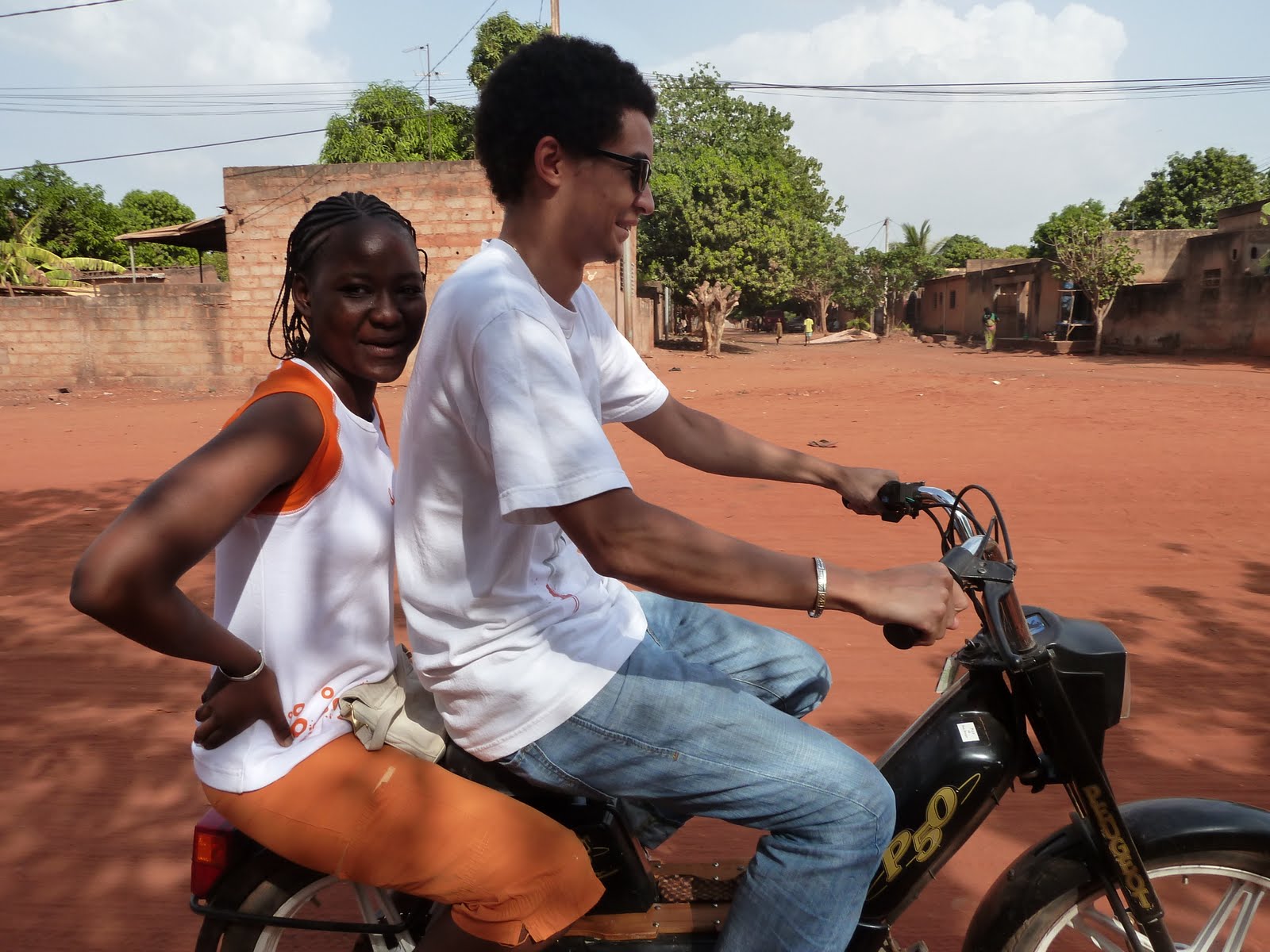
I won’t hash out every day that we spent in Ouaga, but the basic routine was to sleep in a little bit, get something to eat or do a little exploring, go to a movie or two and eat some more.  Since we were feeling a little under the weather we didn’t get to check out much of the night life scene, but Ouaga is full of “maquis,” little outdoor bar restaurants with cheap beer, brochettes, fries, fried plantains, and roasted chickens (yum!!), so we made sure to try the food and drinks at several of those (we even drank beer that you can’t get in Mali!).  We rented a moto for a few days which allowed us to have a lot more freedom and to see more of the city.  It doesn’t feel as big as Bamako, yet there were lots of open and empty spaces (though one can’t really call them green spaces… ) and people and houses didn’t seem as piled on top of one another.  Especially on the south side of the city, the government district which houses the presidential palace (it’s bigger than the white house) and many foreign embassies was eerily empty and undeveloped- think big fancy buildings and compounds in the middle of empty scrubby fields…

YUM- Goat cheese!!
My favorite day of the whole trip was when we visited Loumbila, a small village 30 minutes north of Ouaga.  Thanks to an old guidebook at the NGO where we stayed, we found out about a treasure of a place where the owners raise goats and produce their own goat cheese!!  An aside:  I honestly don’t think I knew how much I loved cheese until I came to Mali.  Sure, one of my college roommates and I had a pact not to bring cheese into our dorm room for fear of devouring it all in a single afternoon, but I never realized that I loved cheese as much as I have in the past months.  You never know how much you love something until it’s gone (or super expensive and hard to get)…. Anyway, I have developed a particular fondness for goat cheese, and so this trip was perfect!  We had herb crusted cheese as an appetizer, and delicious goat cheese salads.  Also, I had goat milk yogurt with sugar for dessert.  Heavenly!  After eating, we explored the area and discovered an odd sort of resort nearby.  It was a little haven tucked into the side of a lake called Loumbila Beach.  We decided to check it out and the individual grass huts, arcade games, bathing suit boutique, bar/restaurant and attractive pool convinced us to stay a while (granted… the boutique was closed, the arcade games didn’t work, and we didn’t eat there… ).  Since we didn’t have our suits with us, we decided (against better judgment) to rent bathing suits for a bargain $2 each!  The swim was marvelous and refreshing and we both (mostly) fit in the suits.  Following our swim we relaxed on the wooden pier stretching out into the lake and giving us a lovely view of the late afternoon sun.  The ride back from Loumbila was enjoyable and we even stopped to do the bumper cars and jump on trampolines at Ouaga’s amusement park.  We are becoming quite the West African amusement park connoisseurs!  It was a wonderful vacation of a day!
Lovely afternoon setting


Relaxing by the lake after a swim at Loumbila Beach


We followed up the great day of swimming and eating with a film at Ouaga’s French Cultural Center.  A word on the films…. FESPACO is a big festival and it would have been impossible (it seems to me) to see all of the films being screened.  There were showings at 8am, 11am, 2pm, 4pm, 6pm, 8pm, 10pm (and even some times in between) at about 10 different locations… that’s a lot of movies!  We opted not to buy a badge ($50 and entry into all films, plus “events”) but instead bought tickets to individual films ($1-$2 a piece).  However, we were too late to find a catalogue of films with titles and descriptions… rather, we just used a schedule that included film name, director name and nationality, and time/location of the film.  Basically, we picked films based on their titles and their countries of origin- not necessarily the best way to do it, but oh well!  Most of the films we ended up seeing had a sort of political undertone… one about the UN Peace Keeping Forces sent to Mozambique after a civil war there in the 1990s (the plot also included bits of traditional witchcraft, and thus some interesting effects), and a film on xenophobic violence in South Africa (black South Africans killing Zimbabwean immigrants).  We saw a film by a Canadian film maker, one from Burundi, and another from Algeria.  It was impressive to see some of the theaters in Ouaga and the films were interesting, though some far more professional than others. 

By the end of the week, we felt like we had seen about all of Ouaga that there really was to see.  The city felt much smaller than Bamako, and far less crowded in most of the neighborhoods.  The streets were more organized (even a designated moto lane!) and cleaner- with few open sewers that are standard along Bamako roadways.  Ouaga was full of bikes, and our host even told us it was second in the world in bikes per capita to China (I take this with a grain of  salt… I mean, what about Amsterdam?).  We bid goodbye to the capital, the festival (and all of the other tourists) and headed back towards Mali on a 4 hour bus ride to Bobo.  At the bus station, we were greeted by Zak’s cousin, Nah, and her friend/neighbor, Chaka.  They guided us in darkness back to Nah and her mother, Ami’s, house.  Frequent power outages linked to the conflict in the Ivory Coast (Burkina is a close neighbor and depends on their power grid for electricity) were characteristic of our stay in Burkina and especially in Bobo.  Because it was too dark to see much, our orientation to the house was minimal that first evening, and we were happy to hit the mattresses after dinner. 

Zak and Nah on her moto
Our stay in Bobo was comfortable and lazy.  It was really nice to be with a family and to get to spend time chatting with Ami, Nah, her friends, and the other people who were in and out of the house.  Ami’s father and Zak’s mom’s stepfather are twin brothers, so Ami maintained that they were direct sisters seeing as twins are really one and the same!  I got to know a lot about the family- her two children (her son is studying in Ghana), her late husband, her time in Mauritania, Niger, and Burkina—I even saw all the family photo albums!  Ami is a true Malian matriarch- a sweet woman, but one who knows how she wants things and tells you about it!  Along with Nah, she is taking care of the handicapped daughter of her deceased sister.  The girl, Hawa, is a twin and her sister is healthy and living in Mali with other relatives.  Ami has been caring for Hawa since she was a baby, and she has made great improvements between that period and her recent 5th birthday.  As it is, though, she is still unable to walk or use most of her left side.  She doesn’t talk, and she spends most of her time with a caretaker- tied on her back, or in a special chair that allows her to sit without falling down.  She was such a sweet girl and really enjoyed attention from visitors- she especially loved Zak!  They played a game with some balled up socks used as a ball- she absolutely loved throwing them at him!  Ami is looking vigorously for a way to help take care of Hawa and get her the therapy she needs to regain control of part of her body and even to walk and talk.  If any of you have any ideas of international organizations who work with handicapped children, I'm all ears!  

I did do something touristy in Bobo- I
visited the beautiful old mosque 
We spent most of our time in Bobo visiting with family and friends.  Nah was a really sweet hostess and we even got to meet her (secret) boyfriend!  We also spent a lot of time with her and her friend, Ben.  He is a really enthusiastic neighbor who wants to learn English, and really wasn’t doing too badly for having little to no instruction (he was, for example, just as good at spoken English as Chaka, who is studying at the University!).  The evening before we left, the four of us were chatting on the front porch after dinner.  Zak started singing “Nah nah nah nah, hey hey hey, goodbye” to Nah, and she got upset because she thought he was taunting her about leaving when she had made it clear she didn’t want us to go.  We decided, though, that this was her song!  We were trying to come up with a song for Ben (I thought of the Michael Jackson song “Ben” about his pet rat) and he said, “Oh I know!  Jingle Ben, Jingle Ben, Jingle all da waaaay!”  Zak and I cracked up and explained to him why this was so funny to us and what the song was really about.    Hanging out with Nah and company was really a joy.  She hopes to come to Mali during the summer months for her vacation from classes, and we hope to see her in Bamako!

Our bus ride home.  Notice the window "altar"
and the yellow jug in the foreground... a
makeshift seat
After a couple of days in Bobo, it was clear that Zak and I were both ready to go home.  I was frustrated that we missed out on the market and didn’t get tickets for the fancy bus home (it was already sold out when we went to get tickets!).  Zak was ready to be home and not have to do the touristy things I was interested in doing (he was a good sport for doing most of them with me).  So, early Monday morning, we got up and got ready to catch our bus back to Bamako.  This bus was much more of an African transportation experience.  It was less organized, dirty, and unairconditioned.  Actually, the lack of A/C was better than I imagined because we were able to get a seat near the front door which was open during the whole ride.  The more annoying part of this trip was that we stopped constantly to pick up people along the route who were hoping to catch a bus to Bamako.  When we boarded the bus, I had been suspicious about why there were big empty water jugs in the bus aisles, and it became clear later that they were for the extra passengers we picked up along the way- no need for them to get a seat, they just sat on the plastic canisters in the aisles!  So, I had two very close “seat” mates… Zak and some guy bundled in a winter coat and ear muffs, sweating by my elbow on a jug in the aisle.  It was definitely great to get off the bus (after a flat tire on the way into Bamako and a painfully frustrating wait for luggage stored underneath) and get a cab back to a good shower and yummy meal.  Just like any vacation, it was fun to get away and exciting to see a new place, but really great to get home!


*As always, you can see more photos (from the trip and recent events) on my Picasa account:  https://picasaweb.google.com/alysmmoore/MaliMarch#

Tuesday, February 22, 2011

'There's No Place Like Home' or 'Change is Good'

It has been so long since I offered an update on things here in Bamako.  Honestly, the time seems to have flown and crept by at the same time!  It is hard to believe that I am 4 ½ months through a 10 month grant!  A lot has happened since I last posted, and I feel as though I find myself now in a period of change.  I hope this post will give a bit of an overall update on the months that have passed since I last blogged. 

Happy New Year from Siby! Love, Ryan, Sonja, Gaelle, Bodil,
Zak, Alys, and George
Many changes have taken place since Decemeber… first and foremost: I have a new home!  As some of you know, after a long and arduous search, I found a lovely little apartment right at the end of 2010.  I have been waiting to write a blog post about the apartment hunt until I had a positive outcome, and now I do!!  The road was long—I saw places that were missing toilets, that involved entrances of rickety stairs leading to the street, that were furnished with plastic chairs and tables yet twice my budget!  Despite precise descriptions of preferred locations and neighborhoods, I saw places in probably a 20 mile radius.  I made a list of agents I used during my search and came up with no less than nine numbers saved in my phone.  And those are just the guys I called!  But after many disappointments (and photos to prove it), I found set of brand new buildings with 16 plausible apartments to choose from. 

A view of the salon in my new home!
My favorite and most receptive agent, Keita, found the place with the help of a friend, and it responded to all my criteria- 1-2 bedrooms, living room, bathroom, kitchen (i.e. a room with a  sink), and it even had extras- a patio, potentially a balcony, and a spacious kitchen (with a satisfactory sink).  I grew excited and realized that the most difficult part of the decision might just be choosing which unit I preferred!  I returned a day later with Bodil for a second opinion, and chose one of the corner apartments with spacious rooms.  The next day I discovered that the price I had been quoted did not match the current asking price.  Following a brief meeting with the building owner, the price had almost doubled overnight!  I was outraged and convinced that he had taken one look at me and decided I could pay more than the 60,000/month (About $130) he was asking.  I decided that the apartment wasn’t even totally finished, this guy must be a jerk, and I would look elsewhere—on principle.  But, after another fruitless week, some seriously whiney frustrated phone calls to my agent, two more visits to the same apartment building with different agents, and a nice conversation with the wife of a fellow Fulbrighter, I decided to take the place.

At my housewarming party with my Malian parents
and sister Bibi
The apartment I had originally “picked” had by this time been reserved by a French man, so I ‘settled’ for my second choice… though in retrospect, I feel I really got the better deal.  I now have a delightful little place with a terrace and balcony, cheery yellow walls, and a slowly developing interior ‘design’ scheme.  After installing most of the furniture, getting cushions made for my couch, and having curtains hung on my doors and windows, I eagerly invited friends and family to show the place off.  The housewarming party was a big hit, and I packed more people on the terrace than a firemarshal would have liked.  Even my Malian parents made an appearance at the soirée!!  Mali has always felt enough like home to me.  I am comfortable here, though sometimes it is a shock to remember that I actually live here- it’s not just that I’m on vacation or visiting friends.  This apartment has helped me remember that over and over again- as I wait for internet installation, or curtain hangers, or look for refrigerators, or try to furnish a seldom used second bedroom (hint hint—I love guests!!)- I really am “home.”

The change in location has been a big one for me, even though I didn’t move too far from my old stomping grounds.  Along with the change in scenery, I have felt like January into February have been major times of change for me in Mali.  The end of the string of holidays has meant I have not been quite as constantly social with other ex-pat friends, and the reality of life is sinking in even more acutely.  Things are “back to normal,” if you will, though for me, trying to describe a “normal” day is difficult.

I think this new year is going to bring with it plenty of new experiences, and I am trying to open myself to all of these- positive and negative.  I have already been getting out of Bamako a bit by ringing in 2011with friends on a mountain in Siby, going to a world class music festival in Segou, and spending more and more time in Banankoro.  I am looking forward to a potential trip to Burkina Faso, some trips around Mali, and maybe a vacation trip or visit from loved ones in the coming months.

Observing at a prenatal care day in Banankoro with
Salif (a community health worker), Doumbia- the head nurse,
and Bintou, a nurse's aide 
One of the biggest recent changes involves my work.  I have spent the last four+ months meeting with my advisor, working on creating a study protocol in English and in French, meeting with different experts in the fields of public health and development, and inquisitively observing in Banankoro once a week or so.  Though this is not particularly taxing (trust me… I have fallen quickly and easily into a routine that would shock most of you.  I am pretty good at doing nothing most of the time…. ), I have not been satisfied with the way my scholarly efforts here have unfolded.  I have done some goal adjustment and tried to remind myself that we constantly have to redefine our objectives, especially when it comes to field studies.  I have also tried to convince myself that I am learning every day whether it happens formally or not, and maybe learning how to pay my electric bill in Africa is an important part of this stage in my life… but I can’t convince myself that the Fulbright committee would see it that way.  To put it simply, I have been a combination of lazy and frustrated about the fact that I am not doing what I came here to do!  And in fact, as I wait and the time drags on, I have come to doubt the very goals that I arrived with so enthusiastically several months ago.

However, some of these things are beginning to change.  Frustrations about not being able to conduct interviews turned last week to frustration with the sheer volume of interviews I tried to conduct in one day!  I have finally turned a corner by really starting my project!  In the past 2 months since the new year, I have been doing more of the waiting game, but this time with some permission to start preliminary interviews.  I found a fabulous research assistant, thanks to the suggestion of a fellow Fulbrighter and friend.  Binta is a young wife and mother trained in Socy/Anth who has more experience conducting field studies and interviews than I do!  She has worked on anti-excision campaigns, and other projects evaluating women’s group projects and health initiatives in Mali!  Last week, we traveled together to Banankoro first for introductions and later to begin work!        

The stage on the river at the music festival in Segou
So to date, I have conducted 6 interviews in 2 days!  Given the way my research crept along the first time I was here in 2009, I was pretty psyched about getting 5 interviews on day one!  I think that there will only be more discussions to come, and already my appetite is whetted by some of the first responses I got from women who have participated in the prenatal education program and are expecting or celebrating the births of children.  A goal for today is revising questionnaires to include even juicier questions about pregnancy and preparation for child birth here in Mali.  These changes certainly will be good ones!

Bumper cars on Valentine's Day
Honestly, many lovely moments have passed since I last wrote an update in December.  I have enjoyed many memorable and delicious meals with friends, heard beautiful music along the riverside in Segou, enjoyed the moonlight on a clear night in Bamako, reveled in a view of the city from the university perched on top of a hill near my house, sweated and smiled in an African dance class, been the first to hold two new babies that I helped deliver, gone on my first Valentine’s Day date, and enjoyed the atmosphere from the balcony of my new home with a book and a beer.  Despite the difficulty that I am having making a big change and getting back into the swing of doing work, I am reminded that all of these lovely moments have come about through moments of change: celebrating the arrival or departure of a friend, taking a trip and changing the scenery, joining a new class and trying a new activity, deepening a relationship- small or large, they all mark moments of transition.

Proudly holding a healthy baby boy that I helped deliver!
To get even more introspective, I could share with you that I am also sensing and anticipating the change that is taking place more generally in my life during these months that I spend in Mali.  I am beginning to ask myself (for better or for worse… ) what comes next.  When I start to really completely freak myself out by wondering where I’ll be in a year or even in 6 months, I try my best to remind myself (and often to convince myself)… Change is good!  My dear friend, Bodil, left Mali at the first of February to return to her home and teaching commitments in Europe.  We spent a lot of time the day of her departure discussing the changes she was going to have to make in her lifestyle in order to return to a routine back at home.  At that moment, it took a little convincing, but we decided that many of the changes would be good ones- regular hot showers, the availability of sushi, the ease of doing things like grocery shopping, the proximity to family, etc.  When I dropped Bodil off at the airport, I gave her a card that said on the front, “There’s no place like home.”  (Yes, I still love the Wizard of Oz… ).  I think that Bodil (and maybe even me at this point) has found a second home here in Mali.  No matter what changes she makes in her location, Mali will always be with her because she is home when she is here.  Maybe just changing the way we think about home is important and really ties these two thoughts together for me.   

I really began to feel the winds of change the night that Bodil left, and I think her departure really impressed upon me the fact that change is good.  And even if not, it’s not irreversible… she’ll  be back in June!  J   


*To see more recent photos, visit https://picasaweb.google.com/alysmmoore

Thursday, February 17, 2011

An Introspective Moment


So, I’ve been on a bit of a hiatus from the blogging world as a lot has been going on in Bamako.  So much, in fact, that I want to devote entire blog posts to some of the specific events that have taken place in the past month.  I hope to write a post chronicling my long, frustrating, and finally rewarding journey to find an apartment, one about my impressions of the police here in Mali (there was a week earlier this month during which I had three run ins with the police…), and another about some of the varied and neat things my friends are doing with their time in Bamako (because they’re all doing pretty cool stuff!!).  Doubtless, the entries about apartment searching and police encounters will be laced with descriptions of the frustration I have experienced and the ridiculousness of some of the protocol here in Mali.  But tonight all of that seems somewhat insignificant given some of the events of the past week. 

I spent my evening thinking about life and death issues… things that go way beyond being stood up for appointments or led on and let down by the internet company (some of the things that have really gotten me down in the past week or so).  My dinner plans tonight were cancelled because my good friend, Bodil, found out that the seven year old son of her best Malian friend, Koti, had died earlier that day.  Bodil has been coming to Mali for several years to do research and has spent almost 2 years (in bits and pieces) living in San, a village north and east of Bamako studying Bogolon mud cloth production.  Koti is a Bogolon artist and the two became good friends in a place where it is often hard to for white women to break into female circles because of language barriers and cultural differences (I often find I relate more to men here because they are more generally the independent, freer thinking sex in Mali).  Koti has been in Bamako for the past six months trying to make money because things in San’s Bogolon world are a bit tight.  So, not unusually, her son has been living with an aunt back in San while his mother is gone for a while. 

Tomorrow, the two friends will get on an early morning bus and make the long journey to San.  But tonight thoughts weren’t on that trip, but rather the gravity of the situation and the greater issues it represents in a country like Mali.  It is never easy when a child dies.  But here, it is not the rare occurrence that it is in Europe or the states.  Here, three hundred children die every day- half of them never reach their first birthday and the rest don’t make it to age five.  Koti’s son made it past both of these milestones, but he died after an apparently sudden illness.  (7 of 10 children who die do so at home without having the opportunity to get care at a health facility) The details of his sickness and death are unclear at this time, but it appears that he became ill suddenly and his health deteriorated so quickly that his mother did not even receive a phone call about his sickness until it was too late.  I imagine that, like many children here, the boy was probably sick for some time with a “standard” respiratory infection, and some other infection took advantage of his suppressed immune system. 

Bodil and I spent several hours discussing the injustice that occurs when a child dies.  She described to me how she initially found the young child a bit bothersome and annoying as small children often are, but that in recent visits she realized he was really growing into a beautiful, kind boy.  We shed tears together as we discussed the multitude of reasons that children here have such a hard road to hoe.  In a sad coincidence, a good mutual friend had also lost a young Malian friend earlier in the week, also in San.  She wrote a moving account on her blog that I think will express some of the thoughts and emotions that I can't here.  I found myself remembering a specific passage in her book, “Dancing Skeletons,” in which anthropologist Katherine Dettwyler reflects on death in Mali.  She spends several pages recounting interviews in which women describe to her their childbearing histories- number of pregnancies, miscarriages, births, and often subsequent deaths.  Her research assistant explains that, “death is a fact of life here in Mali…. Every person has experienced the death of numerous relatives, friends, and neighbors… No on escapes.  You never really get used to it, exactly, but you come to accept it, and even expect it.  A woman expects that some of her children will die.  Why should he be any differend than her grandmother, her mother, her aunts, her sisters, her friends?  You can’t let the death of a child destroy your life.  You have to laugh.  Otherwise you’d have to cry” (Dettwyler 157).

Though I have been told that crying is not appropriate in cases of death here, women do cry.  Dettwyler describes women crying over lost children after twenty or thirty years.  Bodil returned from San reporting that she and her friend Koti had spent a great deal of time crying and grieving together.  I know that just reading these passages out loud to Bodil and talking with her the night she found out about Koti’s son were enough to make me come unhinged.  

I have become interested in the phenomenon of childbirth in great part because it is a universal phenomenon that is approached in a multitude of ways throughout the world.  Similarly, the interpretation of death shares similarities and exhibits differences throughout different cultures.  But I feel comfortable enough making the following generalization based on recent experiences and observations- in almost all cultures and in most situations, birth brings feelings of excitement, happiness, and wonder at a new life entering the world, while universally, death entails at least some sliver of sadness and sobering finality.  Even when Christians rejoice that a soul goes to heaven or Buddhists prepare for reincarnation, I believe that there is a sense of loss involved when a death occurs.

I find myself with little resolution to this post, just as my conversations with friends and reflection time left me with little sense of an “answer.”  Why is it this way?  Why do children here have to fight such a hard battle?  It’s not that there is no answer, it’s just that it is a long, hard, complicated one.  I think all that I can do is use this experience as renewed energy for growth.  It is unfortunate that it takes something so serious to remind me how lucky I am here and in general and how much I have to be positive about.  Maybe that will be this little guy’s legacy… he can remind us to be thankful and positive day in and day out, and to look forward to a day when childhood death is not something to be ‘expected.’ 

*Note- I started writing this post on Jan. 26th, and finished it today- Feb. 17th